In "Must Love Dogs" we are treated to a story of a divorcee as she reels through a life of solitary dinners and set-up dates.
Sarah Hurlihy (played thankfully by the lovely Diane Lane) is a preschool teacher whose recent divorce has sent her entire family on a mad dash to find her a new mate.
She resists the idea and nixes all the date offerings until she meets two men who are worlds apart but whose playful flirtation will push her back into the so-called wagon again.
The first man is his pupil’s promiscuous (which she purposely overlooks) dad and the other is a recent divorcè also who may have a lot more in common with her than she might think. Dermot Mulroney and John Cusack unconvincingly play these men respectively. They are miscast. It could have been the make-up design or lighting, but both men looked so old (much older than I would think their characters ages were). Should I add that their performances border on boredom?
The story has the cutesy feel to it but it fails to elicit anything at all. The pace is slow and scenes are almost repetitive. Even Lane’s performance, although effective and likable, didn’t help at all. Too bad because the trailer was good and I came to the theater expecting to be entertained.
As much as I’d like not to quote a recent review I read about this movie, I just can’t help myself. In that review the writer eloquently wrote: "…must love dogs, must hate this movie…" Ouch!
Oh, there is, however, one scene I enjoyed and gave me reason to stay on until the credits have rolled. During one of the school activities (presumably to establish Lane’s character as a teacher) a dance, very similar to our local Tinikling, was being performed complete with the bamboo poles and the familiar music. Later, the credits called it the "Bamboo Dance." If only they made that dance longer, I would have been distracted some more and perhaps may have made me rethink about this insipid formula.
Thursday, August 18, 2005

Saturday, July 09, 2005
Cinderella Man
James Braddock walks into a lounge where a few of his old boxing cohorts are either busy making deals or are merely relaxing from the boredom of boxing inactivity brought about by the Great Depression. Wearing the face of a man hungry from days of deprivation and dressed in tattered, two-day old clothes, Braddock summons all his courage and swallows all his pride as he asks these men for a few loose change to add to the emergency relief he received from the City.
His eyes welling and his face full of shame, he walks into the middle of the parlor and begs for help. He puts down his cap, takes it out upside down and he starts going around. The men start reaching into their pockets and drops into Braddock’s hat, pennies, dimes, and a few dollar bills.
Of the many memorable scenes in “Cinderella Man”, this one stands out for sheer poignancy.
This particular scene comes about a third into the movie and just for this alone, the price of admission is already considered earned and Russell Crowe, the actor, has proven that surely he is the best actor of his generation. Hardworking and notorious for his temper, Crowe has the gift most actors work their lifetime and yet can’t master but yet in Crowe, it comes off as naturally as breathing and as powerful as the punches he pulls when he becomes James Braddock.
Director Ron Howard has fashioned an underdog fighter formula into one rousing, engaging, touching and inspiring film.
Based on the astonishing true story of the fighter James Braddock who, during the Great Depression, lived with his wife and children in dire, below poverty conditions, yet through sheer determination and willful pursuit of changing his luck managed to turn the fates and became the biggest boxing champion of the era and inspired millions of Americans to have faith in themselves once more.
Among the sterling supporting cast, Renee Zellwegger, who plays Braddock’s wife and the equally-gifted character actor, Paul Giammatti give the most memorable turns. Craig Bierko, who appears late in the movie as the boxer Max Baer, also turns in a menacing performance as Braddock’s final opponent.
During the film’s tense climax, a small interspersed scene, set in a closet, helped underscore the biggest triumph of Braddock’s career. In that scene, the three Braddock children are found hiding and clustering in front of a radio and listening to their father’s fight. A triumph illustrated by the fact that in the heralded scenes of this review, the primary reason why Braddock set all his pride on the side was to able to provide a home for his children, during a harsh winter, with basic gas and electricity, which was cutoff earlier and the children had to be sent away to relatives for their safety.
Braddock's story underscores another telling point: when one man's courage is driven by his love for his family, he can muster all his strength to fight for his own space and deliver the promise to his family. This is the first masterpiece of the year!
His eyes welling and his face full of shame, he walks into the middle of the parlor and begs for help. He puts down his cap, takes it out upside down and he starts going around. The men start reaching into their pockets and drops into Braddock’s hat, pennies, dimes, and a few dollar bills.
Of the many memorable scenes in “Cinderella Man”, this one stands out for sheer poignancy.
This particular scene comes about a third into the movie and just for this alone, the price of admission is already considered earned and Russell Crowe, the actor, has proven that surely he is the best actor of his generation. Hardworking and notorious for his temper, Crowe has the gift most actors work their lifetime and yet can’t master but yet in Crowe, it comes off as naturally as breathing and as powerful as the punches he pulls when he becomes James Braddock.
Director Ron Howard has fashioned an underdog fighter formula into one rousing, engaging, touching and inspiring film.
Based on the astonishing true story of the fighter James Braddock who, during the Great Depression, lived with his wife and children in dire, below poverty conditions, yet through sheer determination and willful pursuit of changing his luck managed to turn the fates and became the biggest boxing champion of the era and inspired millions of Americans to have faith in themselves once more.
Among the sterling supporting cast, Renee Zellwegger, who plays Braddock’s wife and the equally-gifted character actor, Paul Giammatti give the most memorable turns. Craig Bierko, who appears late in the movie as the boxer Max Baer, also turns in a menacing performance as Braddock’s final opponent.
During the film’s tense climax, a small interspersed scene, set in a closet, helped underscore the biggest triumph of Braddock’s career. In that scene, the three Braddock children are found hiding and clustering in front of a radio and listening to their father’s fight. A triumph illustrated by the fact that in the heralded scenes of this review, the primary reason why Braddock set all his pride on the side was to able to provide a home for his children, during a harsh winter, with basic gas and electricity, which was cutoff earlier and the children had to be sent away to relatives for their safety.
Braddock's story underscores another telling point: when one man's courage is driven by his love for his family, he can muster all his strength to fight for his own space and deliver the promise to his family. This is the first masterpiece of the year!
Sunday, June 26, 2005
Batman Begins
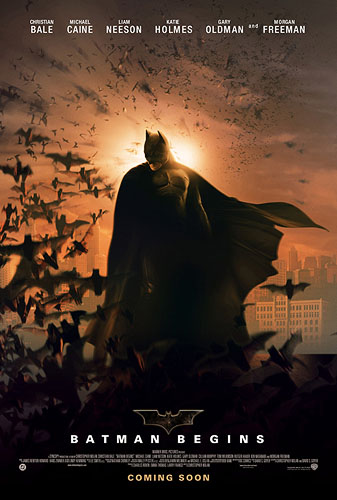
In “Batman Begins”, Director Christopher Nolan attempts to recreate the lost charm of the caped crusader otherwise known as the Dark Knight er Batman.
Critics from all over have lavishly praised this movie with some calling it “one of the best films of the year.”
Well a good film it is but the best film it isn’t. I can’t even say it’s the best Batman in the series. Tim Burton’s original 1989 “Batman” and the sequel “Batman Returns” are definitely much better. This Batman may have focused on how the myth of Batman came into being, but it did not, however, provide an engaging villain (count this as my first complaint) that would have truly made this particular hero super.
Alright, to begin with, we are told of how the young Bruce Wayne encountered his first bat experience. This frightening episode would create a manic phobia that would eventually cause him to lose both his parents to a mindless homicide outside of a theater.
With his parents dead, Bruce goes on a soul-searching expedition that would take him to the heart of Mongolia, to the lair of a mysterious Vigilante group which may or may not have had a hand in the death of his parents.
His strong conviction to avenge his parents’ death paved the way for him to join this band of mercenaries. He was trained in the art of martial art combat amidst freezing temperatures atop frozen mountains. For his final test, he is summoned to kill a captured murderer. He balks from the challenge and instead he kills everyone except for his teacher (Liam Neeson).
When Bruce returns to the city, he pretends to be a playboy and starts his crusade against the dark elements of Gotham.
Rachel Dawes (Katie Holmes) does not figure in the story yet and even without her the movie would still have hold. Holmes’ performance does not allow the audience to feel her presence. I wanted to believe that because they were childhood playmates, Batman er Bruce Wayne would go to great lengths to save her from the evil Scarecrow (Cillian Murphy) in the guise of saving the city?
Don’t get me wrong. I enjoyed this movie and Christian Bale as Batman is amazing. He has the charisma of Michael Keaton. I was just challenged to question some of its aspects in the light of its almost universal acclaim.
Nolan returns to the roots of the Batman series and he succeeds in building the myth; the concluding parts, however, sadly, was just normal action formula.
One last complaint, the action sequences are incomprehensible. The training scenes are terrible. Oh, I’m gonna get the ire of all batman fans, but why do I care when I can’t even fathom the change in Bruce Wayne’s voice whenever he transforms into Batman!
The best part of the movie? Gary Oldman's scenes. The master thespian returns in a minor role that appears bigger because of his usual acting prowess.
Posted by Hello
Subscribe to:
Posts (Atom)


 Posts
Posts


